What Jhandi Munda is
Also written jandi munda, jhande munda, jandi mundi and janji munda, and known as Langur Burja in Nepal.
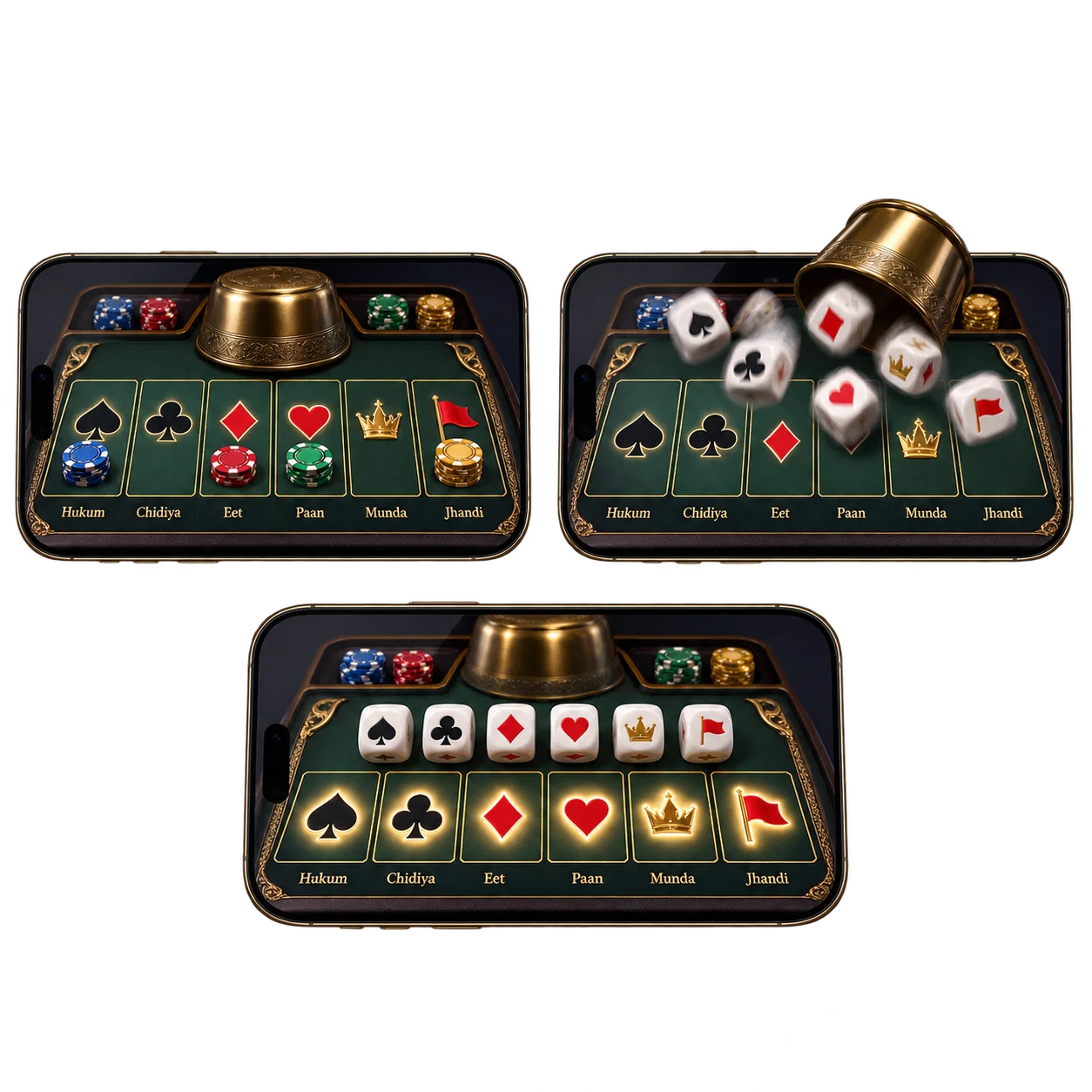
A board is marked with six symbols. Players put money on whichever ones they fancy. Six dice are thrown together, each carrying the same six symbols on its faces, and then revealed. If your symbol did not come up at all, the stake goes to the house. If it came up, you are paid according to how many dice showed it.
That is the whole game. It is fast, it is decided entirely before the throw, and it is easy to keep playing without ever deciding to. People also search for it as luck ka khel jhandi munda, which is an accurate description: pure chance inside a fixed structure.
The only choice in Jhandi Munda is how much and how often.
How a throw runs
On a cloth in a market or in an app on a phone, the sequence is identical.
- Stakes go down
You back one symbol, or spread across several. Spreading does not improve your position, it splits it.
- The dice are covered and thrown
Six dice together. In an app this is a random draw of six values, shown afterwards as an animation.
- The dice are revealed
Count how many show your symbol. That single count is the only thing that matters.
- Payment
Nothing showing means the stake is lost. One or more pays according to the count, at whatever rate the board states.
How often your symbol actually lands
Six dice, six faces each. This distribution is fixed. It is the same on every board, in every app, on every night.
Two rows carry the whole story. You lose outright about a third of the time, and when you do win, the win is the smallest possible one far more often than not. A single die showing your symbol accounts for roughly three fifths of every winning round you will ever have.
The results people talk about are genuinely rare. Three dice happens about once in nineteen throws, four once in a hundred and twenty four. All six is once in forty six thousand six hundred and fifty six, which at a throw a minute is once in about a month of continuous play.
Why this beats any strategy. Those percentages do not move. They are not affected by the last throw, by which symbol is running hot, by the hour of the night or by how much you staked. Six dice with six faces produce that distribution and nothing changes it.
Where the operator actually makes money
Not in the dice. In what the board agrees to pay you.
The traditional rule, as usually written down, gives you the stake back plus one times the stake for each die showing your symbol. Two dice returns three times your money, three returns four, and so on.
Run that against the distribution above and it does not favour the house, which tells you something worth knowing: the payout schedule is where each operator sets its margin, and it is not always the traditional one. Some pay less on the higher counts. Some take a commission on wins. Some cap the top result.
So the single most useful thing you can do before playing anywhere, cloth or app, is read the paytable and check what each count returns. The dice are honest. The paytable is the negotiation, and it is the part almost nobody reads.
Version 1.1.1 · 34.3 MB · Android 5.0 or later · 18+ only
The chart question, answered honestly
A lot of people arrive here looking for a Jhandi Munda chart.
Result charts exist. Apps keep a history panel, and you will find spreadsheets and Telegram posts tracking which symbols came up over hundreds of throws. What none of them can do is tell you what comes next.
Each throw is independent. A symbol absent for twenty rounds is not owed anything, and one that has appeared five times running is not on a streak that means something. Those are the two beliefs people carry to the table, they contradict each other, and they are wrong for the same reason: the dice have no memory.
A chart records what happened. Reading it as a forecast is the most expensive habit in this game.
What changes when the board is a screen
Same game, three differences that matter.
Pace
A market stall runs a few throws a minute at most, with talking in between. An app runs continuously, and the next round opens before you have finished thinking about the last. Volume is what a margin feeds on, so this is the difference that costs the most.
Stake size
On a cloth you are limited by the coins in your hand. In an app the balance is a number and topping it up takes four taps, which removes the friction that used to do the stopping for you.
The throw itself
On a board you watch the dice land. In an app the result comes from a random number generator and the animation is drawn afterwards to match. That is normal rather than dishonest, but it does mean you are trusting the operator instead of physics, which is a good reason to care who the operator is.
What people ask
How many dice are used in Jhandi Munda?
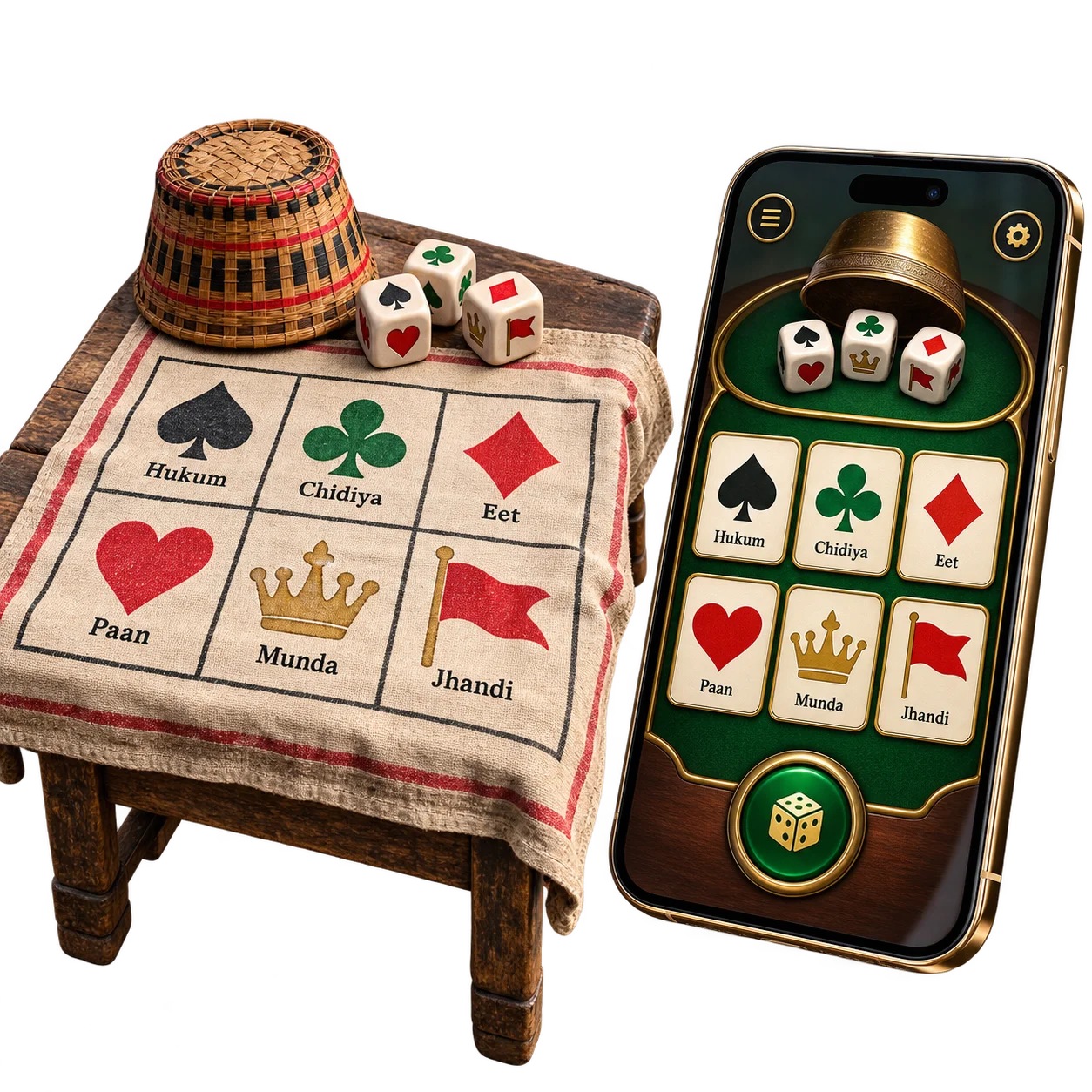
Six, thrown together. Each die carries all six symbols, one per face, so any of them can show any symbol.
What do the six symbols mean?
Four are card suits under their Hindi names: hukum is the spade, chidiya the club, eet the diamond and paan the heart. The other two name the game: munda is the head or crown, jhandi is the flag.
What are the odds of winning a round?
Your symbol appears on at least one of the six dice about 66.5% of the time, so you lose outright roughly one round in three. What you are paid when it does appear depends on the count and on the paytable in use.
Is there a Jhandi Munda trick or strategy?
No. Every throw is independent and every symbol is equally likely, so nothing you do beforehand changes the distribution. The only lever that exists is how much you stake and how long you play.
Does a Jhandi Munda chart help predict results?
It cannot. A chart records what already happened, and the dice do not carry that history into the next throw. Treating a record as a forecast is the most common and most costly mistake in the game.
Is Jhandi Munda the same as Langur Burja?
Yes. Langur Burja is the Nepali name for the same six dice, six symbol game, and it belongs to the same family as Crown and Anchor, the British version played with three dice.
Can I play Jhandi Munda online for free?
Most apps carry a practice mode on demo credit, with the same board and dice. It is the right place to learn the interface. It cannot pay out, and it cannot reveal a system that works, because there is not one.